

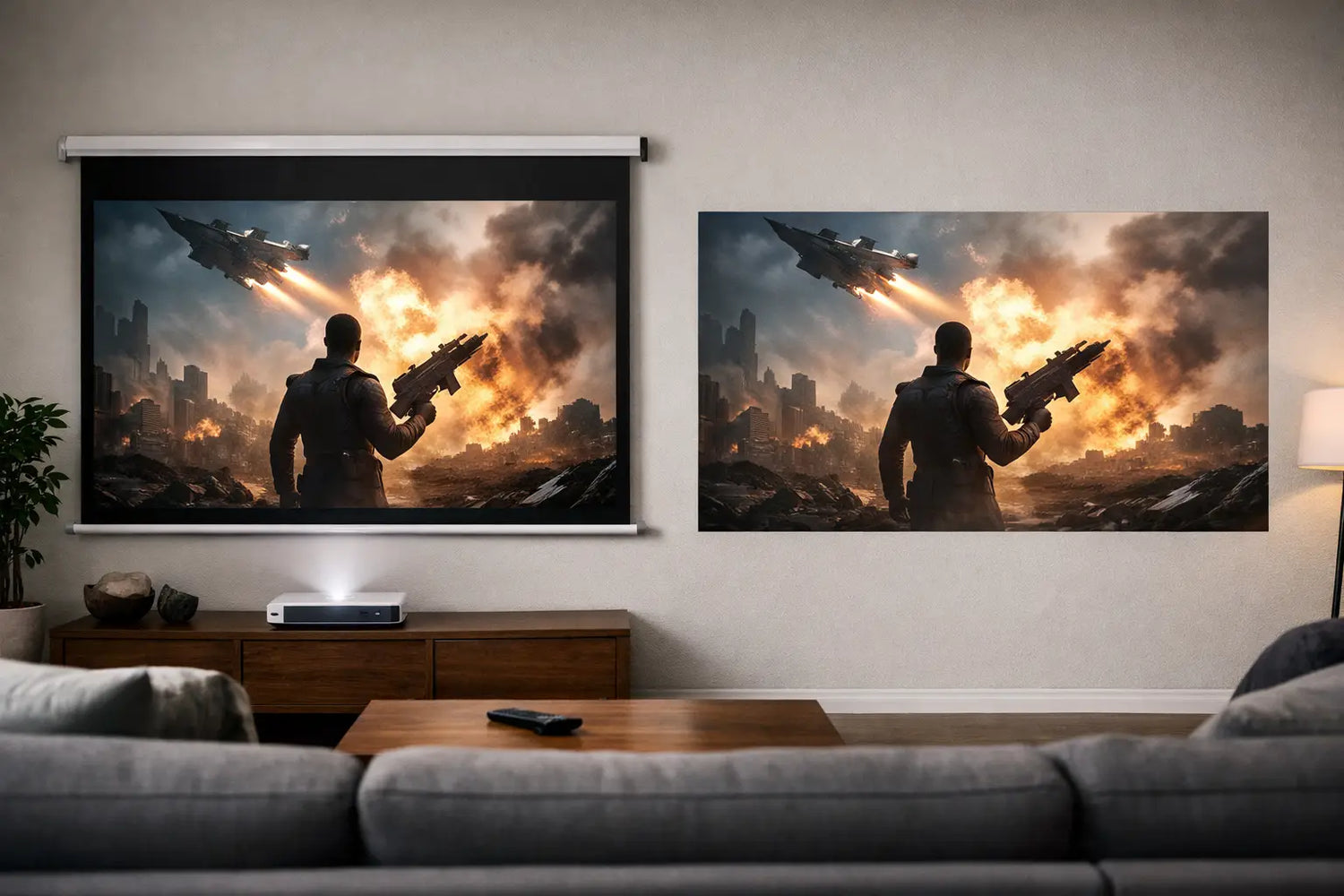
You can spend serious money on a projector, dial in the seating, add surround sound, and still miss the full cinematic payoff if the image is landing on the wrong surface. That is why projector screen vs wall is not a small detail. It is one of the biggest factors in how sharp, bright, and polished your room will feel once movie night starts.
For some spaces, a plain wall is perfectly acceptable. For others, it leaves too much performance on the table. If your goal is a truly elevated home cinema, the right answer depends on your room, your projector, your lighting, and how refined you want the final result to look.
Projector screen vs wall: what actually changes?
The biggest difference is not whether an image appears. It will appear on both. The real difference is how controlled that image looks.
A dedicated projector screen is engineered to reflect light evenly and predictably. That means more consistent brightness, cleaner whites, better perceived contrast, and a smoother surface. A wall, even one that looks flat to the eye, usually has texture, minor imperfections, paint inconsistencies, or subtle color tint that affect the picture.
In premium rooms, those differences are obvious. Skin tones look more accurate on a proper screen. Motion appears cleaner. Dark scenes hold together better instead of looking muddy. Even menu text and subtitles often appear crisper because the surface is more uniform.
If you are building a room meant to impress guests, satisfy a serious movie enthusiast, or complement high-end speakers and seating, a projector screen usually delivers the finish people expect from a luxury setup.
When a wall works well
A wall is not automatically the wrong choice. In fact, for casual viewing, multi-use family rooms, or first-time projector owners, it can be a smart starting point.
If the wall is smooth, clean, and painted a neutral matte white or light gray, it can produce a decent image - especially at night or in a darkened room. For sports, streaming, gaming, and occasional movie nights, many homeowners are happy with the result.
This approach also keeps the room visually simple. There is no screen housing, no installation hardware, and no extra purchase. If you are still deciding on projector placement or room layout, using the wall first can help you test screen size before committing.
The trade-off is consistency. A wall can look surprisingly good one day and underwhelming the next, depending on ambient light, projector angle, and how forgiving the content is. Animated films and bright sports broadcasts often hide flaws. Darker, more cinematic content exposes them fast.
Best-case scenario for using a wall
A wall makes the most sense when the room is light-controlled, the projector is reasonably bright, and expectations are practical rather than perfectionist. It is also useful in flexible spaces where the projector is part of a lifestyle setup, not a dedicated theater.
If that sounds like your room, a wall may be enough for now. Just be honest about what you want from the experience.
Where a projector screen pulls ahead
A dedicated screen is where image quality becomes more deliberate. It gives your projector a surface designed for projection rather than one that simply happens to be available.
That matters even more as projector quality increases. A premium projector can only show what the surface allows. Put an excellent projector on a mediocre wall and you cap the performance immediately.
Screen materials are designed for specific environments. Some maximize brightness. Some improve black levels. Some reject ambient light better than a painted wall ever could. Some are acoustically transparent for advanced installations where speakers sit behind the image, creating a true cinema layout.
There is also a visual discipline to a screen. The image has a defined border. The room feels intentional. The whole setup reads as custom rather than improvised. For design-conscious homeowners and dedicated media rooms, that difference is part of the value.
Light control changes everything
Ambient light is often the deciding factor in projector screen vs wall. In a dark room, the wall may hold up reasonably well. In a living room with windows, sconces, or open-plan lighting, a proper screen can save the experience.
Ambient light rejecting screens are especially effective in brighter spaces because they help preserve contrast and prevent the image from washing out. A painted wall simply does not have that engineering behind it.
So if your room is not blackout-controlled, a screen moves from nice-to-have to highly recommended.
Picture quality: the details most people notice first
Most buyers focus on projector specs, but the surface affects what your eyes notice within seconds.
Brightness is one of the first things that changes. Some screens have gain that helps reflect more usable light toward the viewer. That can make the image feel punchier and more alive. A wall usually offers less controlled reflectivity, so brightness can feel flatter.
Color accuracy is another factor. Walls are rarely perfectly neutral. Even a small undertone in the paint can warm or cool the image. Screens are built to avoid that problem.
Then there is texture. Many interior walls have orange peel, roller marks, patchwork, or tiny surface waves. These imperfections can soften the image and become visible during bright scenes or slow camera pans. A good screen presents a cleaner canvas, which helps your projector look more expensive than it otherwise would.
Cost: is a wall the better value?
At first glance, yes. The wall is already there. That makes it the cheapest option by far.
But value is not just about spending less upfront. It is about whether the final result matches the level of investment in the rest of the room. If you already own or plan to buy a quality projector, receiver, speaker package, and seating, saving on the display surface can become a false economy.
A projector screen does add cost, but it also protects the performance of every component around it. In many cases, it is the upgrade that makes the whole room click.
That said, not every room needs a premium motorized model. Fixed-frame screens offer a strong balance of performance and price for dedicated rooms. Manual and pull-down options can suit flexible spaces. Motorized screens are ideal when clean aesthetics matter and you want the image to appear only when needed.
Aesthetics and room design
This is where the decision becomes more personal.
Some homeowners prefer the minimalist look of a blank wall, especially in modern living areas. Others want the visual authority of a framed screen that signals this room is built for entertainment.
A wall disappears when not in use. A screen, depending on the type, can become part of the architecture. Recessed or motorized solutions keep things sleek. Fixed-frame screens create a strong focal point, especially in dedicated theaters.
For high-end interiors, the right choice is usually the one that feels intentional. A luxury room should not look like equipment was added as an afterthought. It should feel integrated from the start.
Which option is right for your room?
If you use the space casually, mostly watch at night, and want to keep the budget tight, a wall can do the job. If the wall is smooth and the paint is right, you may be pleasantly surprised.
If you care about image precision, watch a lot of movies, entertain guests, or are designing a room around premium AV performance, a projector screen is the stronger choice. The improvement is not just technical. It changes the whole impression of the room.
For mixed-use spaces, the answer often lands in the middle. A motorized screen can preserve the room's design while giving you real performance when it matters. That balance is exactly why many custom installations go this route.
The better question than projector screen vs wall
Instead of asking which one is universally better, ask what level of experience you want every time you turn the system on.
If you want something simple, flexible, and cost-conscious, the wall may be enough. If you want the image to feel cleaner, richer, and worthy of a premium setup, a proper screen is usually the move. That is especially true once room lighting, interior design, and long-term satisfaction enter the equation.
At AmpliMart, this is where specialist guidance matters. The right projector, screen type, gain, placement, and room treatment should work as one complete system, not as isolated purchases.
A great home cinema does not happen because the image is big. It happens when every surface, speaker, and sightline works together - and the screen choice is often the detail that separates a decent setup from a room people remember.

Leave a comment
This site is protected by hCaptcha and the hCaptcha Privacy Policy and Terms of Service apply.