

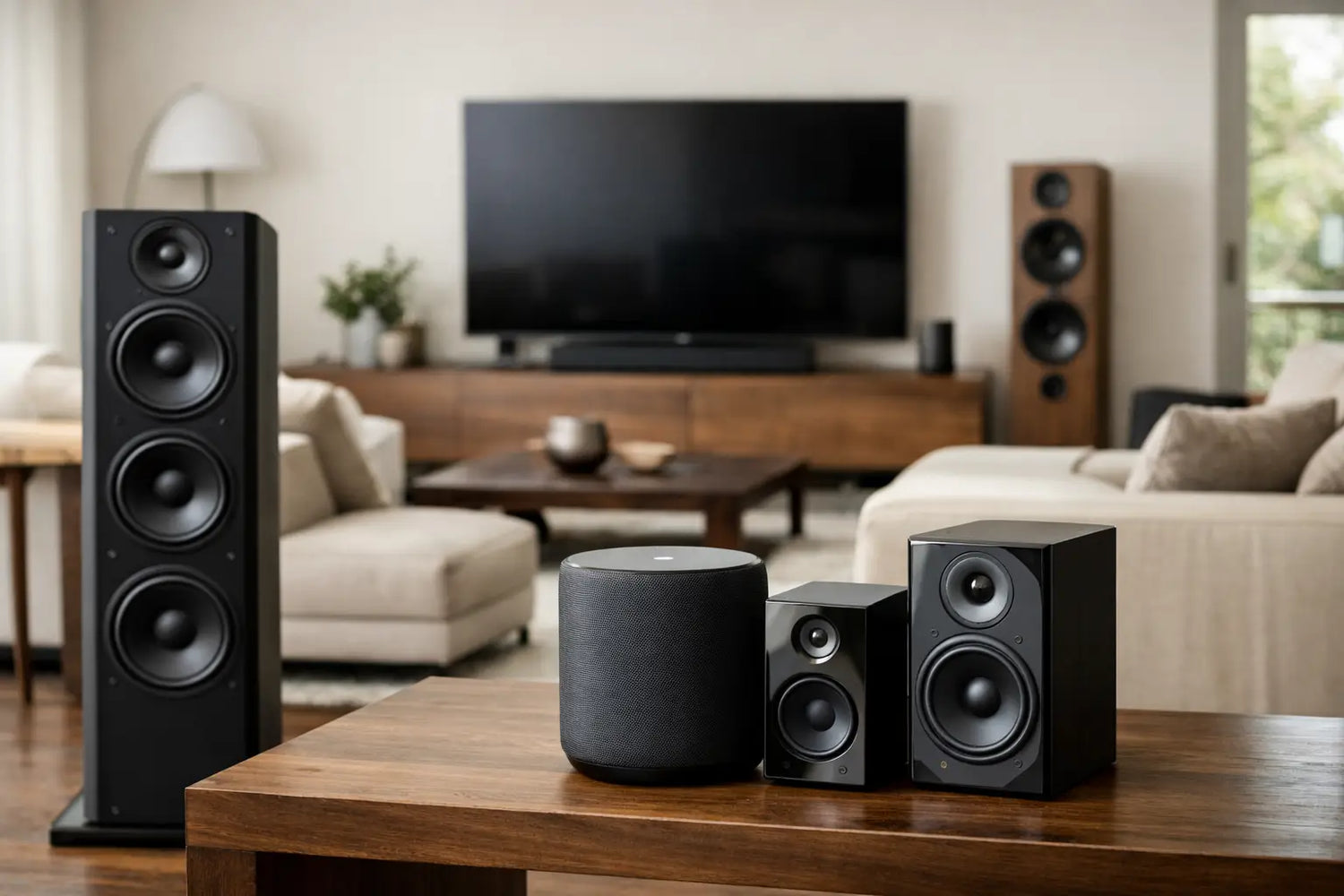
A large living room can make weak speakers sound expensive and disappointing at the same time. You turn the volume up, the dialogue still feels distant, the bass disappears into open space, and the room never quite delivers the cinematic impact you expected. That is why choosing the best speakers for large living rooms is less about chasing hype and more about matching speaker design, power, and placement to the scale of the space.
What large rooms demand from a speaker system
Big rooms are not forgiving. They swallow energy, spread bass unevenly, and expose thin or underpowered speakers fast. If your living room has high ceilings, open-plan connections to a dining area, hard floors, or long glass walls, the challenge gets even tougher.
In a smaller room, a compact pair of bookshelf speakers can sound rich and satisfying. In a large living room, that same setup may feel polite, especially when you want full-bodied music, theater-level dynamics, or effortless volume without strain. The goal is not simply louder sound. The goal is scale, authority, and control.
That usually means looking at speakers with greater cabinet volume, larger drivers, higher sensitivity, and stronger low-end performance. It also means thinking beyond the speakers themselves. Amplification, subwoofer support, room layout, and acoustic treatment all affect the result.
Best speakers for large living rooms: what to prioritize
If you want a system that sounds premium instead of merely powerful, start with output capability. Large spaces need speakers that can move enough air to fill the room without sounding harsh when pushed. Floor-standing speakers are often the natural first choice because they offer larger woofers, better scale, and more physical presence than compact models.
Sensitivity matters too. A speaker with higher sensitivity can produce more volume from the same amount of amplifier power. That does not automatically make it better, but in a large room it gives you more breathing room. If you enjoy dynamic movie soundtracks or live recordings, this becomes especially important.
Bass extension is another major factor. In larger rooms, low frequencies need help. Some tower speakers offer impressive bass on their own, but many open-concept spaces still benefit from one or two subwoofers. This is where premium system design starts to separate itself from basic shopping. A great room-filling setup is not always about buying the biggest pair of towers. Sometimes it is about building the right combination.
Floor-standing speakers are usually the right starting point
When customers ask about the best speakers for large living rooms, floor-standing models are usually where the conversation begins. They are built for scale. Taller cabinets allow for multiple drivers, better bass reach, and a soundstage that feels more anchored in a bigger environment.
For two-channel music systems, a strong pair of towers can create a luxurious, effortless presentation that makes the room feel alive even at moderate listening levels. For home cinema, they deliver the front-stage weight that action scenes, orchestral scores, and deep dialogue need.
That said, not every tower is automatically right for every big room. Some lean warm and smooth, which works beautifully in bright, reflective spaces. Others are more revealing and energetic, which can be thrilling in a well-treated room but a little aggressive in a glass-heavy interior. Speaker character matters just as much as size.
When bookshelf speakers can still work
Bookshelf speakers are not disqualified, but they need support. In a large living room, a premium bookshelf pair paired with one or two capable subwoofers can outperform mediocre towers. This approach also gives you more flexibility with placement and often cleaner imaging.
The trade-off is obvious. You are relying on precise crossover integration, smart subwoofer placement, and enough amplifier quality to keep the system cohesive. If you want a cleaner visual footprint without giving up full-range impact, this route can be excellent. If you want simplicity, towers tend to be easier.
Why subwoofers matter more than most buyers expect
One of the biggest mistakes in large-room audio is assuming the main speakers should do everything. They should not. Even impressive floor-standing speakers can struggle to deliver even, convincing low bass across a spacious room.
A dedicated subwoofer handles the heavy lifting where room size becomes a real obstacle. In movie setups, it brings scale and realism. In music systems, it adds foundation, body, and ease when integrated properly. In large rooms, dual subwoofers are often worth serious consideration because they help smooth bass across multiple seating positions.
This is not about making the room shake for the sake of it. Premium bass should feel controlled, deep, and intentional. You should sense the room opening up, not hear a boomy box in the corner.
The amplifier and AV receiver make or break the result
A large-room speaker setup is only as convincing as the electronics driving it. Underpowered amplification is one of the fastest ways to make expensive speakers sound flat, thin, or strained. Bigger speakers often need serious current delivery, especially if their impedance dips low or their sensitivity is modest.
For music-first systems, a quality integrated amplifier can bring out the control and sophistication that larger speakers need. For cinema systems, an AV receiver must have enough real-world power and processing capability to manage your channels confidently. In some cases, adding external amplification is the move that transforms a system from decent to commanding.
This is where expert matching matters. Great speakers paired with the wrong electronics rarely sound great for long.
Placement in a large living room is not optional detail
In premium audio, placement is performance. Large rooms often tempt people to spread speakers too far apart or push them tight against walls to preserve floor space. Both decisions can compromise balance.
Front speakers usually benefit from some breathing room from the back wall and side walls. Toe-in should be adjusted based on the speaker design and listening position. Subwoofers need experimentation, especially in open-plan spaces where bass can collect in one zone and vanish in another.
If the room is visually driven, as many luxury living rooms are, the best setup is often a balance between design and acoustics. Clean installation, concealed cabling, furniture spacing, rugs, curtains, and acoustic panels can all improve performance without making the room feel technical.
Matching the speaker type to how you actually use the room
A large living room is rarely a single-purpose space. It may be where the family watches movies, where guests gather, where background music plays during dinner, and where late-night listening needs to stay refined rather than overwhelming. That is why the right speaker system depends on your priorities.
If movies dominate, go with a home cinema layout built around substantial front speakers, a matched center channel, surround speakers, and at least one serious subwoofer. If music comes first, a high-quality stereo setup with full-range towers or bookshelf speakers plus subwoofer support may give you more satisfaction day to day. If you want both, a carefully designed hybrid system is the smarter investment than a compromise package bought in pieces.
This is exactly where a specialist approach pays off. Premium customers are not just buying boxes. They are buying a result - scale, clarity, visual polish, and confidence that every component belongs together.
Common mistakes to avoid in big living room audio
The first mistake is buying based on small-room reviews. A speaker praised as punchy or room-filling in a condo can fall apart in a 500-square-foot living area. The second is overspending on speakers while ignoring the amplifier, subwoofer, or room acoustics.
Another common issue is choosing lifestyle speakers purely for looks when the room clearly needs more output and extension. Design matters, especially in beautiful homes, but performance still has to lead. The best systems do both.
Finally, avoid building a large-room setup one random component at a time. Compatibility problems, tonal mismatch, weak bass integration, and installation compromises usually cost more to fix later.
What a premium large-room system should feel like
The right system should make the room feel intentional. Dialogue should stay clear even when people are seated off-axis. Music should have body and width without turning edgy at higher volume. Bass should feel present across the room, not trapped in one seat. And visually, the system should belong in the space.
That is the difference between simply owning speakers and creating a high-performance entertainment environment. At AmpliMart, that mindset drives every serious audio conversation because large living rooms do not need generic recommendations - they need systems built for real scale, real lifestyles, and real expectations.
If you are investing in better sound for a bigger space, think beyond the speaker spec sheet. The best choice is the one that fills the room with ease, fits the way you live, and still feels impressive long after the first movie night.

Leave a comment
This site is protected by hCaptcha and the hCaptcha Privacy Policy and Terms of Service apply.