

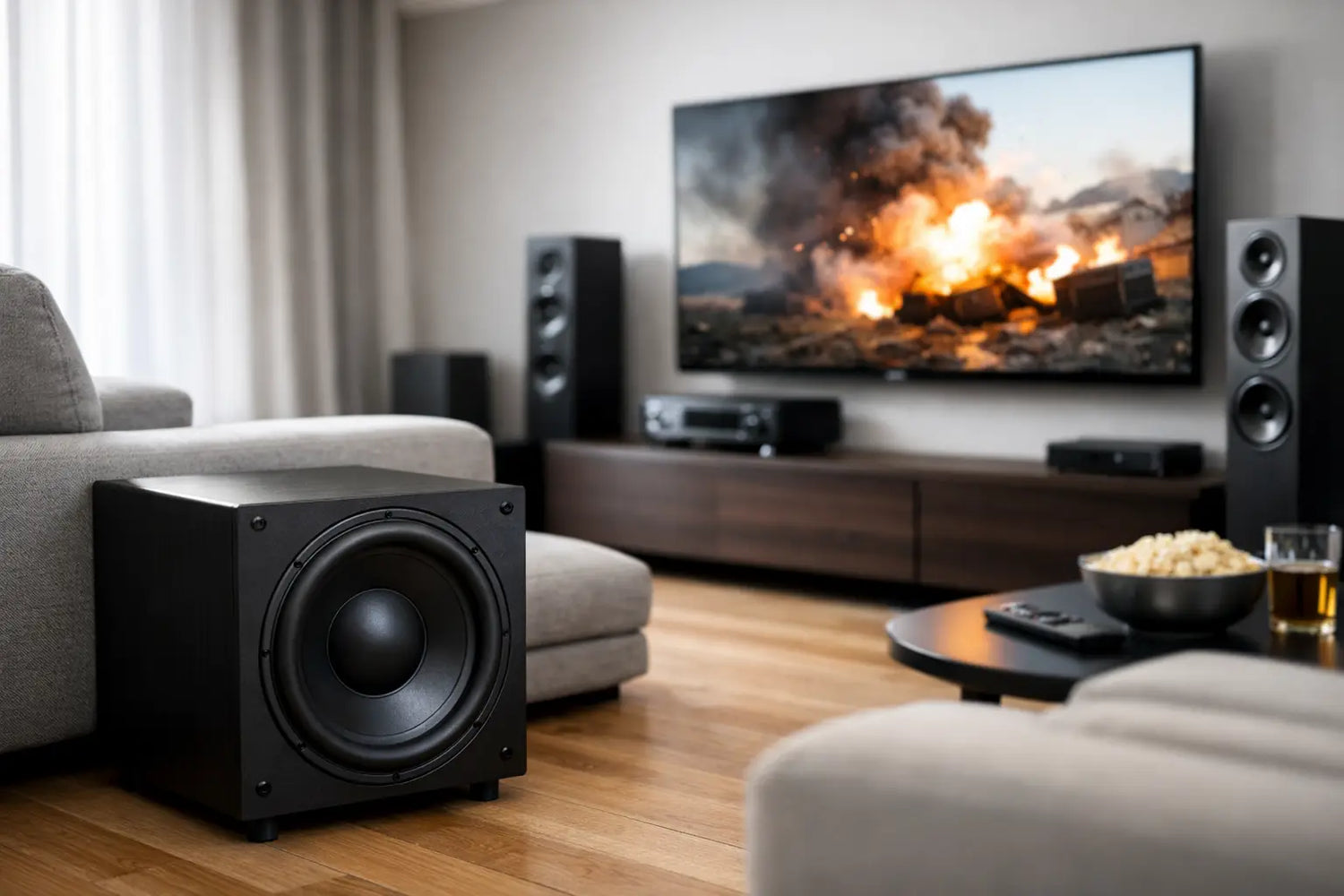
A subwoofer can make a movie feel massive or completely ruin it. When the placement is off, explosions turn boomy, dialogue gets muddy, and bass disappears from one seat only to overwhelm the next. If you want the best subwoofer placement for movies, the right answer is not "just put it in the corner" - it is where your room lets low frequencies hit hard, stay controlled, and feel cinematic across your seating area.
That matters more than most buyers expect. Premium speakers, a powerful AV receiver, and a serious display can still feel underwhelming if the bass is trapped by poor positioning. In a home cinema, subwoofer placement is not a finishing touch. It is part of the performance.
Why subwoofer placement changes movie sound so much
Low frequencies behave differently from the rest of your system. Bass waves are long, they interact aggressively with room boundaries, and they pile up or cancel out depending on where the sub and seats are placed. That is why a subwoofer can sound tight and authoritative in one spot, then loose and bloated just a few feet away.
For movies, this is even more noticeable. Film soundtracks depend on impact and scale. You want the low-end swell of a score, the weight of a door slam, and the pressure of action scenes without hearing a one-note rumble hanging around after every effect. Good placement helps the sub disappear into the room so you feel the bass rather than localize it.
Best subwoofer placement for movies: where to start
The best starting point is usually along the front wall of the room, somewhere between the front left and front right speakers. This tends to integrate well with the soundstage and supports a cohesive cinematic presentation. In many living rooms and dedicated media rooms, this is the most practical place to begin because it keeps cabling clean and works well with furniture layout.
A front corner is often the next place people try, and for good reason. Corner placement boosts output by using two nearby walls to reinforce bass. If you want more slam and extension, a corner can deliver it. The trade-off is that it may also exaggerate room modes, making some notes sound too strong and others too weak. For action-heavy movie watching, that extra energy can be thrilling, but only if the bass stays controlled.
Mid-wall placement can smooth things out in certain rooms, especially when a corner sounds too thick or uneven. It usually gives up some raw output in exchange for better balance. If your room already has strong bass reinforcement or your subwoofer is especially capable, this can be a smart move.
The worst place in many rooms is wherever it simply fits visually with no testing at all. A hidden cabinet nook, a tight shelf opening, or a random sidewall spot behind furniture can choke performance fast. Premium cinema sound deserves better than convenience-only placement.
Use the subwoofer crawl if you want the real answer
If you only try one setup method, make it this one. The subwoofer crawl is still one of the most effective ways to find the best subwoofer placement for movies in a real room.
Place the subwoofer temporarily at your main listening position. Then play a bass-heavy movie scene, a low-frequency sweep, or steady test tones. Walk around the perimeter of the room, especially along the front wall, corners, and sidewalls, and listen for the spot where bass sounds deep, even, and clean rather than boomy or thin.
That position is often where the sub should go. It is not glamorous, but it works because it flips the room interaction in a way your ears can evaluate quickly. In high-performance rooms, this simple process often reveals that the obvious-looking spot is not the best-sounding one.
Corner vs wall placement
Corner placement for maximum impact
If your goal is chesty, cinematic energy, a front corner is often the fastest route. It can make a moderate subwoofer sound bigger and help large rooms feel more pressurized. For blockbuster movies, that added authority is a real advantage.
The catch is control. Corners can overemphasize certain frequencies, especially in square or minimally treated rooms. If bass feels like a constant drone instead of distinct effects, the corner is giving you quantity over quality.
Front wall placement for balance
A position on the front wall, slightly off-center, is often the sweet spot for people who want strong bass without turning every action scene into a blur. It usually blends better with your main speakers and keeps the low end feeling anchored to the screen.
For design-conscious setups, this location also tends to look cleaner. That matters in luxury media rooms and open-plan spaces where performance and presentation have to work together.
Sidewall placement when the front wall fails
Some rooms simply refuse to cooperate on the front wall. Large openings, built-ins, asymmetrical furniture, or deep nulls at the main seats can force a different solution. In that case, a sidewall location can outperform the obvious options.
It may not be the first choice aesthetically, but if it fixes uneven bass across your seating area, it is worth serious consideration. Great cinema is heard first.
One seat or every seat
This is where expectations need to be realistic. A single subwoofer can be optimized for one main listening position or made reasonably good across several seats, but rarely perfect everywhere. If you care most about the center recliner, placement can be more aggressive. If you host family movie nights and want consistent bass across a sofa row, the strategy changes.
That is where dual subwoofers become more than a luxury upgrade. Two subs placed strategically can smooth room response and reduce the dramatic peaks and dips that one sub often creates. Common layouts include both front corners, midpoints of opposing walls, or diagonally opposite corners. The right arrangement depends on the room, but the result is often more even, more refined, and more expensive-sounding.
For premium home cinema builds, this is often the difference between impressive bass and truly finished bass.
Setup mistakes that ruin good placement
Even strong placement can underperform if the setup is careless. Crossover settings matter. Phase matters. Level matching matters. Auto-calibration helps, but it is not magic.
If the subwoofer is too loud, the room sounds heavy and slow. If the crossover is too high, bass becomes localizable and can muddy male vocals. If phase is off, the sub can partially cancel your main speakers around the crossover region, leaving a hole right where impact should live.
A smart starting point is setting your main speakers to small in the AV receiver and crossing them over around 80 Hz, then fine-tuning by ear and measurement. For movies, you want authority without bloat. That balance is what separates a premium cinema room from a loud one.
Room design changes the answer
A dedicated theater with acoustic treatment, sealed boundaries, and planned seating gives you far more control than a bright, open living room with tile floors and one wall missing into a dining area. The room always has a vote.
Hard surfaces can make bass feel more aggressive. Large openings can rob it of pressure. Symmetrical rooms can create obvious peaks and nulls, while asymmetrical spaces may be trickier to predict but sometimes easier to smooth. If your room has acoustic panels, bass traps, thick rugs, and substantial seating, your placement options expand because the room itself is already working with you.
That is why serious results come from treating the room and system as one project. At the premium end of home entertainment, equipment quality and room strategy need to move together.
When to stop chasing and call the setup done
Perfection is not always the target. For movies, the goal is powerful, clean, convincing bass that supports the screen and feels consistent in the seats that matter most. If your sub blends in, delivers impact without boom, and keeps dialogue clear during heavy scenes, you are close.
If you are still moving the sub every weekend, the issue may not be placement alone. It could be room acoustics, seat position, calibration, or simply asking one subwoofer to cover too much space. That is usually the point where a better installation plan, room treatment, or a second sub starts making more sense than endless trial and error.
The best theater rooms do not happen by accident. They are built with intention, from speaker choice to seat layout to bass management. That is exactly why customers investing in serious cinema performance work with specialists like AmpliMart - not just to buy premium gear, but to get a room that sounds as elevated as it looks.
Before you upgrade anything else, give your subwoofer a better home. The right placement can make your next movie night feel less like a system test and more like the private cinema experience you were paying for all along.


اترك تعليقًا
This site is protected by hCaptcha and the hCaptcha Privacy Policy and Terms of Service apply.