

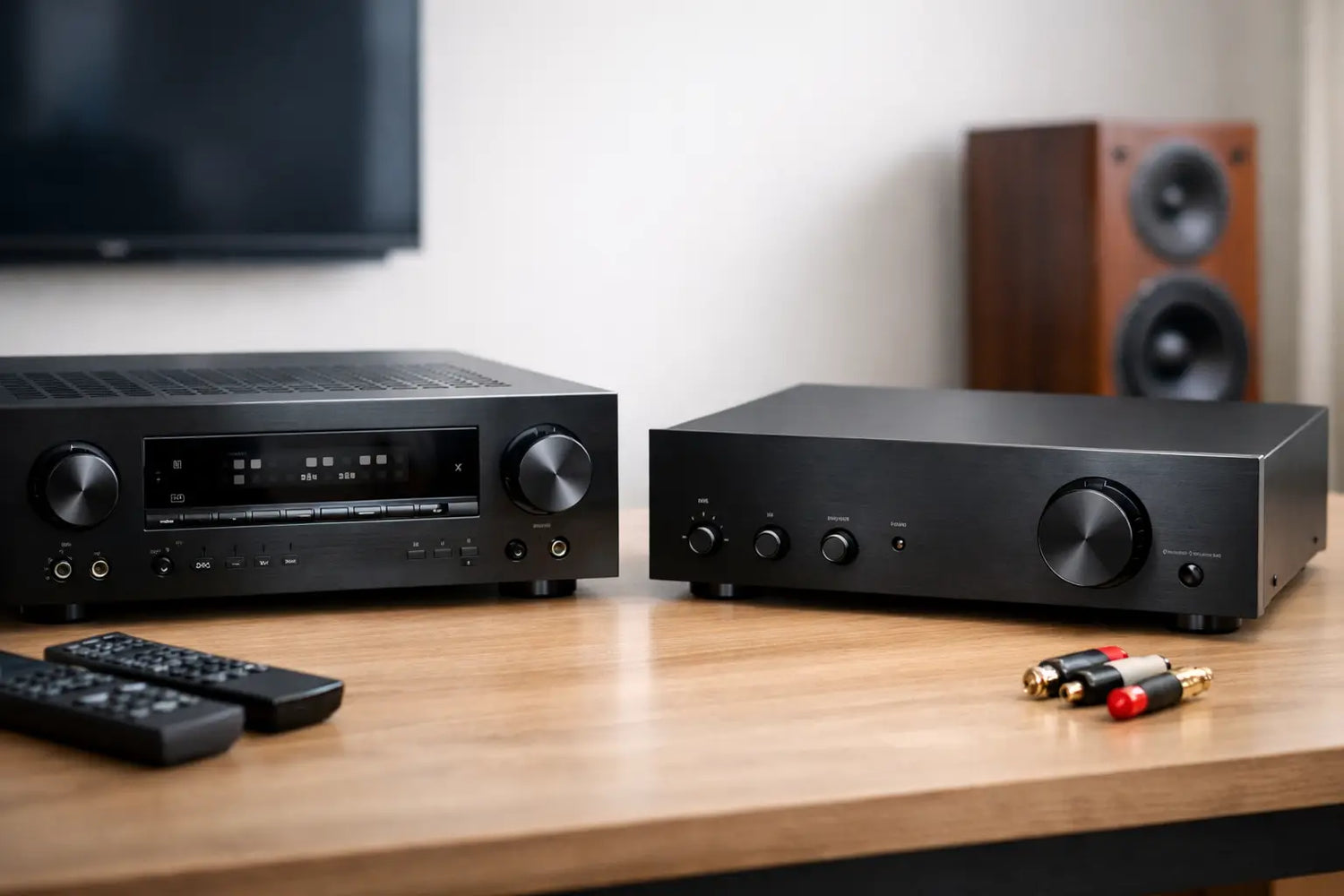
Picture your room finished the right way - a clean rack, serious speakers, a screen that drops, and sound that feels bigger than the walls. Then comes the question that shapes the whole system: av receiver vs amplifier. It sounds simple, but the right answer depends on what you want the room to do, how many sources you use, and whether your priority is pure two-channel performance or full cinema control.
For many buyers, this is the point where a beautiful project either comes together or gets needlessly complicated. An amplifier can be the smarter choice for focused music listening. An AV receiver can be the stronger move if you want your room to handle movies, gaming, streaming, and multi-speaker surround without adding separate boxes. The best option is not the one with the longest spec sheet. It is the one that fits your room, your habits, and the experience you actually want every night.
AV receiver vs amplifier: the core difference
An amplifier is built to amplify an audio signal and send power to your speakers. In a traditional HiFi setup, that usually means two-channel stereo. You connect a music source, pair it with quality speakers, and let the amp focus on clarity, control, and musicality.
An AV receiver does that job and then goes much further. It acts as the command center for a home theater system, handling audio processing, video switching, HDMI connectivity, surround sound decoding, room calibration, and often streaming features as well. It is designed for people who want one component to manage TV audio, movie soundtracks, gaming consoles, media players, and multiple speakers across the room.
That is why this comparison is not really about which product is better. It is about which role you need filled. If your system is mainly about music, simplicity, and refinement, an amplifier often wins. If your system needs to run an entertainment space, an AV receiver is usually the more complete solution.
When an amplifier makes more sense
If you care most about stereo music, an amplifier has a strong advantage. A good integrated amplifier puts more of the budget into power delivery and audio quality rather than surround processing and video features. That often translates into cleaner sound, better channel separation, and a more focused listening experience.
This matters in rooms where music is the main event. Think of a stylish living room with floor-standing speakers, a turntable, and a streamer. Or a private listening space where detail, texture, and control matter more than explosive surround effects. In setups like these, a dedicated amplifier can sound more deliberate and more refined than an AV receiver at a similar price point.
There is also a usability benefit. Amplifiers are typically simpler. Fewer menus, fewer signal paths, less chance of feature overload. For buyers who want premium sound without turning the system into a tech project, that simplicity is attractive.
The trade-off is flexibility. Most amplifiers are not built to manage a full surround system, multiple HDMI sources, or advanced room correction for theater use. Some modern integrated amps include DACs, streaming, and even HDMI ARC, but they still are not replacing a true AV receiver if cinema is your main goal.
When an AV receiver is the better buy
If the room is built around movies, sports, streaming, and gaming, an AV receiver is hard to beat. It brings everything under one roof. You connect your display, your content sources, and your speaker system, and the receiver handles switching, decoding, amplification, and system control.
That convenience matters more than many people expect. A well-chosen AV receiver lets you build a clean, centralized setup instead of stacking separate processors, switchers, and amps. It is the practical heart of most home theater rooms because it turns multiple components into one cohesive experience.
More importantly, it is designed for immersion. Surround formats, center channel dialogue, subwoofer integration, and speaker calibration all work together to create the kind of cinematic sound that a basic stereo amplifier simply cannot produce on its own. If your goal is to feel action scenes, hear precise movement around the room, and make a large screen sound worthy of the image, an AV receiver is the right foundation.
This is especially true in family spaces and media rooms. One device can support movie nights, console gaming, TV streaming, and even multi-room audio in some cases. For households that want performance without juggling separate boxes, that is a serious advantage.
Sound quality: is an amplifier always better?
This is where the conversation gets more nuanced. In pure two-channel listening, many amplifiers do outperform AV receivers at the same budget. They are optimized for stereo playback, and that focus often shows in the sound.
But that does not mean AV receivers sound weak. A quality receiver paired with the right speakers can sound excellent, especially in real-world rooms. And once you factor in room correction, subwoofer integration, and center channel support, the total experience for film and TV often becomes far better than what a stereo amplifier can deliver.
So yes, an amplifier may win the audiophile argument in a dedicated music setup. But in a multi-use entertainment room, overall enjoyment often leans toward the receiver because it is doing the job the space actually demands.
The bigger mistake is chasing theoretical sound quality while ignoring room purpose. Great systems are built around use case first, then performance upgrades second.
Features, connectivity, and future plans
A big part of the av receiver vs amplifier decision comes down to connectivity. If you have a TV, projector, streaming device, gaming console, media player, and several speakers, an AV receiver is built for that reality. HDMI inputs, eARC support, bass management, zone outputs, and app control all make daily use easier.
An amplifier is usually more selective. That is not a flaw. It is part of the appeal. You get a cleaner signal path and a more intentional system. But you may need external components for streaming, phono input, DAC duties, or source switching depending on the model.
Think beyond today. If you expect the room to grow into a full cinema setup, buying a stereo amp now may save less money than you think if you later need to replace it with a receiver or add more processing gear. On the other hand, if you know you are building a serious two-channel music system and staying there, an amplifier is often the better long-term investment.
Room type matters more than most buyers expect
The right answer changes with the room. In a dedicated theater with a projector, acoustic treatment, and multiple speaker positions, an AV receiver is the natural centerpiece. It is built to organize complexity and create immersion.
In a luxury living room where design matters just as much as sound, an amplifier may fit better. Two excellent speakers, a compact subwoofer, and a premium integrated amp can deliver a polished result without visually crowding the space.
Open-plan homes also need careful thought. A surround system may look great on paper but become awkward in a shared space. In that case, a strong stereo setup can be the smarter and cleaner solution. The point is not to force a category. It is to match equipment to architecture, lifestyle, and expectations.
Budget and value
If you compare entry-level options, AV receivers often look like incredible value because they include so much in one box. For theater buyers, they usually are. You get amplification, processing, switching, and control in a single purchase.
Amplifiers can seem more expensive for what appears to be fewer features. But feature count is not the whole story. With a stereo amp, more of the money may be going into power supply quality, internal components, and audio performance rather than surround licensing and video circuitry.
That is why value depends on the system goal. For a movie room, the receiver often gives you more useful capability per dollar. For a music-first setup, the amplifier may give you better sound quality where it counts.
Which should you choose?
Choose an amplifier if you want premium stereo sound, a cleaner setup, and a system centered on music. It is ideal for listeners who value refinement and do not need a room full of speakers or multiple HDMI sources.
Choose an AV receiver if you want one component to power a true entertainment room. It is the right call for surround sound, movie impact, source management, and all-in-one convenience.
For many homeowners building a polished media space, the answer is simple: if the room is meant to impress with cinema-scale performance, start with the receiver. If the room is meant to seduce with pure musicality, start with the amplifier. And if you are investing in a premium result, the smartest move is to build the system around the room, not just the product category. That is where specialist planning pays off, and where a brand like AmpliMart can help turn good equipment into a finished experience.


Leave a comment
This site is protected by hCaptcha and the hCaptcha Privacy Policy and Terms of Service apply.